
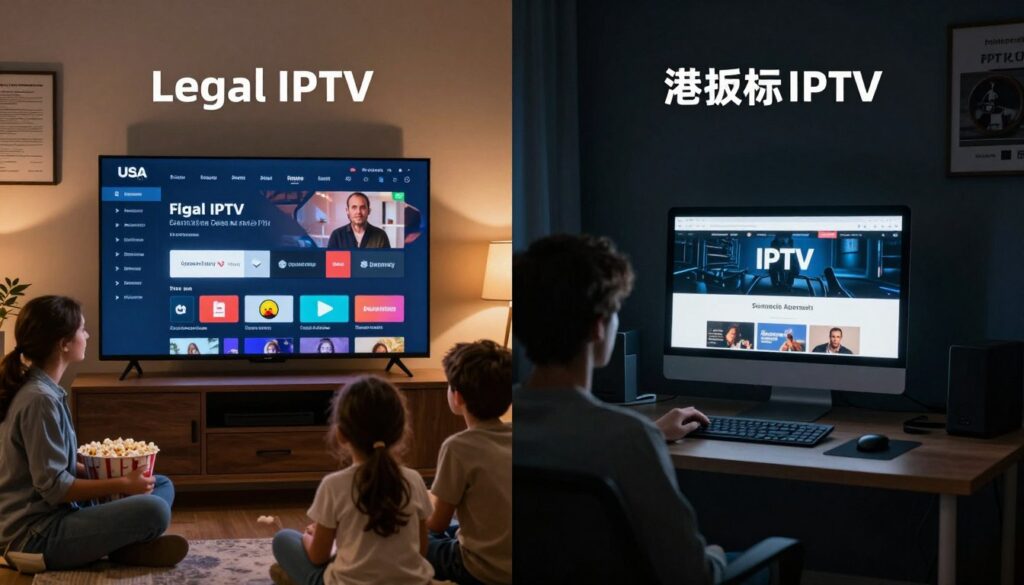
Curious which streaming offers are safe for you in Canada and which are risky? You’ll learn how the split between licensed and unlicensed services really works, and why it boils down to permissions and rights—not the fact that video travels over the internet.
You’ll get a clear U.S. framework first, then a Canada-focused view you can use today. Expect simple checks you can run before you sign up with any provider.
Many people chase big channel lists and low prices. That’s tempting, but those signals often mean missing streaming rights and weak accountability. This guide will cover content rights, reliability and quality, payments and privacy, customer support, and the laws that matter.
This is an educational guide to help you choose more safely, without alarmism. You’ll also see examples of trustworthy services and a quick checklist to vet any provider in minutes. When you’re ready, check GetMaxTV for a legal IPTV subscription option that fits Canadian viewers.
Key Takeaways
- You’ll learn why licensing—not the internet delivery—defines compliance.
- Simple checks can reveal if a service is accountable and authorized.
- Big channel counts and low prices can signal missing rights.
- Quality, payments, privacy, and support differ between providers.
- This guide gives practical steps and examples for Canadian viewers.
- See the checklist to vet any service in minutes and consider GetMaxTV for a legal subscription.
What IPTV means today and why “legal vs. illegal” depends on the provider
IPTV stands for Internet Protocol Television. It simply means television delivered over IP networks so you can watch on smart TVs, set-top devices, phones, tablets, and computers.
Technology vs. service: The term can mean the delivery method — the protocol television technology that routes video over networks — or it can mean an iptv service that packages channels and on-demand shows for you. The delivery method is neutral; the provider must hold distribution rights for content to be legitimate.
How IPTV and OTT compare
Both use the internet and apps, so people mix them up. OTT streaming services like Netflix use the public internet and scale broadly. Managed IPTV often runs on dedicated capacity and can mimic cable habits: channel guides, low latency, and steady bitrates.
Practical takeaway: Don’t ask whether IPTV is legal in general. Ask whether a specific provider is licensed to distribute the channels they offer in your region. For more detailed information on rights and compliance, see this explanation of distribution rights.
Now that you know the terms, the next sections compare what reputable iptv providers do versus how unlicensed operations typically work.
Legal IPTV service: what makes an IPTV provider legitimate
A trustworthy streaming provider starts with clear rights to the shows and channels it offers.
Licensing and permissions from copyright holders
Licenses matter. A legitimate service pays networks, studios, and sports leagues for distribution rights. That payment is what lets a provider stream content without risking copyright infringement.
Transparent business signals
Look for openness. Clear terms of service, a privacy policy, refund rules, and a reachable support team show a provider operates like a real business. These details make it easier for you to trust billing and data handling.
Official apps on major app stores
Apps listed on Apple, Google, or Amazon stores pass basic reviews. That presence isn’t proof alone, but it is a positive signal that shady software is less likely.
Pricing and what to expect
Licensed channel bundles cost more to run. If a subscription looks impossibly cheap for major networks or live sports, be skeptical.
- Examples you may recognize: Hulu, Sling TV, YouTube TV, FuboTV, DirecTV Stream, Pluto TV.
- Smaller providers can be legitimate too if they show rights and transparency.
For a practical checklist to verify a provider before you subscribe, see this quick guide.
Illegal IPTV services: how unlicensed streaming usually works
Some services build huge channel lists by rebroadcasting captured feeds rather than buying distribution rights. You should know how that sourcing works so you can spot red flags before you pay.
How pirated streams are sourced and redistributed
Operators often copy live broadcasts, use stolen account credentials, or pull feeds from rehosters. They then re-encode and stream those signals to subscribers without permission.
Common packaging: “all channels,” “global sports,” and VOD bundles
Marketing plays a role. Promises of every channel and global sports packages are designed to lure buyers. In reality, such bundles usually mean rights were never purchased market-by-market.
| Offer Type | What it claims | Typical issue |
|---|---|---|
| All channels bundle | Huge channel lists for one low fee | Missing regional rights; unstable lineups |
| Global sports pack | Live sports from many countries | Streams drop during big events; blackout risk |
| VOD libraries | Thousands of movies and shows | Outdated catalogs; malware risk from sideloaded apps |
Why reliability problems happen during big live sports and news events
When many viewers tune in for a big game or breaking news, these systems hit capacity fast. Hosts get overloaded, streams buffer, or feeds vanish when rights holders act.
“A stream that works on a quiet night can fail at the moment you need it most — during a big match or breaking story.”
Practical takeaway: Even if a cheap package seems to work now, peak events reveal real performance and safety issues. Using such services can expose your devices, data, and money to unnecessary risk.
legal iptv vs illegal iptv in usa key differences

Your viewing choice affects more than channel lists — it shapes reliability, privacy, and dispute options.
Content rights and copyright risk: Legitimate providers pay for distribution and list clear rights. That payment reduces copyright infringement exposure for everyone. By contrast, unlicensed sellers often rebroadcast without permission, which creates legal risk for operators and can complicate matters for users.
Service quality and user experience differences
Authorized services usually offer stable apps, accurate guides, and consistent streams at peak times.
Unofficial services may show dead links, broken EPGs, and buffering during major events.
Payments, account security, and data handling
Reputable providers use standard billing, receipts, and clear privacy policies.
Risky sellers often prefer crypto or anonymous payments and disclose little about account security.
Accountability: who you can actually contact
With a proper company you can dispute charges, open support tickets, and read terms.
With fly-by-night sellers a chat handle may vanish when the service stops.
| Aspect | Authorized services | Unlicensed sellers | What it means for you |
|---|---|---|---|
| Content sourcing | Paid licenses; partner disclosures | Rebroadcasts; unclear sourcing | Reliability and copyright exposure |
| Playback quality | Consistent streams and updates | Buffering and dead channels at peaks | Predictable viewing vs interruption |
| Payments & records | Standard billing and receipts | Crypto or anonymous methods | Disputeability and refund options |
| Support & accountability | Reachable support and policies | Ephemeral contact info | Ability to resolve problems |
Bottom line: You’re not just picking channels — you’re choosing how content, payments, and your account security are handled. For a short vetting checklist, see this quick guide to safe subscriptions.
US law overview for IPTV streaming and copyright compliance
U.S. statutes set the rules that decide whether a stream is cleared for public viewing or not. At the center is a simple idea: permission from rights holders is the foundation for lawful distribution of channels and on‑demand libraries.
How the DMCA shapes online streaming
The DMCA (1998) supports copyright enforcement on the internet. Practically, it means providers must secure licenses or risk claims of copyright infringement.
For you this matters because services that show major networks or live sports usually need explicit rights. If a service can’t prove permissions, reliability and long‑term access are at risk.
What changed with the 2020 federal update
The Protecting Lawful Streaming Act raised penalties and made it easier for authorities to target operators who run large-scale unlicensed services. Enforcement focuses mostly on the people behind offerings, but the effects can be immediate for users.
- Enforcement is complex and selective, but takedowns and app removals still happen.
- When a provider is shut down, your subscription and access can end without notice.
Viewer takeaway: legal pressure usually lands on operators first, yet instability and sudden shutdowns affect you directly. If you want steady access to sports, news, and shows, adopt a compliance mindset and pick providers that show clear permissions.
For more background information on rights and compliance, see this overview of streaming law.
Canada context: what you should know when you’re watching from Canada
If you watch from Canada, the rules around streaming hinge on who holds distribution rights and where those rights apply.
Canada’s Copyright Act works much like U.S. statutes: the focus is permission to distribute specific content. That means whether a service can show a channel depends on contracts, not on the fact that video travels over the internet.
Notice-and-notice and recent changes
The notice-and-notice system lets rights holders ask ISPs to forward warnings to accounts tied to suspected activity. It is meant to inform users, not to punish them immediately.
Reforms in 2019 tightened the process: notices can’t demand settlements or request personal data. That change reduced pressure tactics that led some viewers to pay when they didn’t have to.
Practical takeaway: Global-style offers that ignore regional rights are a red flag. If a provider lists far more channels than regional rights would allow, you may face service instability or other risk.
For background on how services deliver streams, see this what is IPTV guide.
Clear signs an IPTV service is legal
Spotting a trustworthy streaming option comes down to clear business signals, not slogans. Watch for simple proof points that make verification fast and reliable.
Partner and network disclosures
Legitimate providers often name who supplies each channel. You should see partner links, network logos, or channel lists that match public records. That openness shows the service pays for content and has nothing to hide.
Normal payment methods and clear billing
Look for credit card billing, invoices, and an easy cancellation path. A fair subscription policy and a reachable support contact are strong indicators that payments are traceable and disputes can be resolved.
Region-appropriate content and availability
Legal services limit some channels by country because rights are sold regionally. If a provider offers every premium sports feed worldwide, that mismatch is a red flag. Regional limits often mean licensing is being respected.
Quick checklist you can use:
- Named business entity and contact info
- Transparent terms, privacy policy, and refund rules
- Clear channel lineup with partner or network credits
- Standard billing, invoices, and easy cancellation for your subscription
- Region notes that explain which channels are available where
When in doubt, compare what a service claims to actual partner disclosures and network pages. For a compact vetting tool, see this short vetting guide. Transparency and alignment with how licensing works are the best signs a service legal provider can be trusted.
Red flags that point to using illegal IPTV
A few clear signals often reveal when a streaming offer is risky. Watch for odd business practices, strange app installs, and payment methods that block recourse.
Prices that don’t match the channels promised
If a service offers dozens of premium channels and a huge VOD library for a tiny fee, it likely skips real licensing costs.
Such low prices can indicate unstable lineups and sudden shutdowns.
Crypto-only or untraceable payments
Requests for crypto, gift cards, or other untraceable payment methods are a warning. They reduce your ability to dispute charges or get refunds.
“Use VPN for the optimal experience”
A VPN is fine for privacy, but demands to use vpn to make things work often mask geo‑restrictions or dodgy sourcing.
Sideloaded apps, sketchy plugins and device risk
Apps outside official stores and third‑party plugins can carry malware, trackers, or unstable updates. They also expose your devices and accounts.
No verifiable company details or offshore hosting
When a provider lists no real address, no partners, and offshore servers, treat that as a major red flag. These setups vanish fast when trouble starts.
“A good rule: if two or more of these signals appear, pause and look for a transparent alternative.”
| Red flag | What it likely means | Action you can take |
|---|---|---|
| Too-good prices | Missing rights; unstable channels | Compare with mainstream costs and ask for partner proof |
| Crypto / gift card payments | Untraceable payments; low consumer protection | Avoid; choose services with standard billing |
| VPN required | Geo-issues or detection avoidance | Ask why a VPN is needed; prefer region-compliant options |
| Sideloaded apps & offshore host | Malware risk; provider may disappear | Use apps from official stores and check company registration |
Bottom line: If you spot multiple red flags—especially around payments, apps, or vague company info—step back and vet other services before you subscribe.
Risks beyond legality: what you trade away with illegal IPTV
A tempting price can mask threats to your devices, privacy, and account safety. When a service cuts corners, those costs often show up on your end.
Malware, phishing, and device exposure
Unofficial apps and fake download pages can carry malware or phishing hooks. You may see shady installers, fake “play” buttons, or ad-heavy players that request broad permissions.
If you install unvetted apps on a streaming stick, Android box, phone, or PC, malware can steal credentials or inject unwanted software.
Scams, disappearing services, and no consumer protection
Some services take payment, change domains, and vanish. That leaves you without refunds or a contact to resolve charge disputes.
These patterns hurt users who expect a steady viewing experience and standard recourse when things go wrong.
Privacy and data handling
Vague policies and aggressive ad stacks can enable data harvesting and resale. That means tracking across sites, targeted ads, or even third-party sales of viewing records.
Account safety and overall experience
Poor billing practices increase the chance your payment details are exposed. Weak login controls and no receipts make account security harder to enforce.
Practical step: Prefer providers that publish clear terms and normal billing. If you want a vetted option to compare, see this best IPTV subscription 2025 for a safer starting point.
“If multiple red flags appear—odd payment methods, sideloaded apps, or vague policies—pause and verify before you subscribe.”
How to choose a safe IPTV experience that fits your viewing needs
Start by listing the channels and shows you can’t live without, then match that list to providers that actually carry them where you watch. This quick prioritization saves time and avoids noisy offers that pack lists but drop content at peak moments.
Match must-have channels, shows and live sports
Write down locals, news networks, favorite shows, and the sports you follow. Then check provider lineups and press or partner pages to confirm they truly offer those channels.
Check devices and whether a set-top box or app is required
Confirm support for your devices—smart TV, Apple TV, Fire TV, Android TV, phone, tablet, or PC. If a set-top box is needed, learn who makes it and whether updates come from official stores.
Confirm internet speed expectations for HD and 4K
Aim for about 10–15 Mbps per stream for HD and about 25 Mbps+ for 4K. Add headroom if multiple people stream at the same time to keep a smooth viewing experience.
Try before you commit: test a service for a week or month, watch at the times you usually watch, and check cancellation steps.
Tip: For current offers and verified 4K bundles see this top 4K live deals to compare what services offer and whether they match your needs.
Legal IPTV options you can compare in the US and Canada
Compare reputable streaming packages to find a plan that fits your channels and device needs.
Examples of verified services and why they qualify
Well-known options: YouTube TV, Hulu + Live TV, Sling TV, FuboTV, DirecTV Stream, and ad-supported Pluto TV. These services operate under paid distribution agreements, publish partner details, and offer official apps on major stores.
Where GetMaxTV fits
If you prefer a straightforward subscription with clear terms, GetMaxTV is a practical choice to compare. For plans and more information, you can review details at https://getmaxtv.com.
What to review before you subscribe
Quick checklist:
- Confirm the channel lineup and whether the content is licensed for Canada.
- Check device and app support for your TV, phone, or streaming stick.
- Verify billing methods, receipts, and the cancellation policy.
- Read the privacy policy and test support responsiveness.
- Match your needs: sports fans need proven rights and uptime; families may want parental controls and multi‑stream support.
“Pick a service that lists partners and shows a clear refund path — it keeps surprises to a minimum.”
Conclusion
Choosing a streaming plan comes down to who holds distribution permissions, not the delivery tech.
Think of IPTV as a protocol: the deciding factor is whether a provider has rights to the channels and content it offers. Authorized services show partner credits, normal billing, and clear policies. Unlicensed sellers often use risky apps, odd payment methods, and offer little accountability.
If you value steady access for live sports, breaking news, and prime‑time shows, pick a provider with verified permissions and transparent support. Use the green/red flag checklist from this guide to vet offers before you subscribe.
For more background on availability and compliance, see is IPTV legal. If you want a vetted subscription option, check GetMaxTV’s current offer at https://getmaxtv.com.
FAQ
What does IPTV mean today and how does legality depend on the provider?
IPTV is simply a way to deliver television over the internet. Whether a service is lawful depends on who owns the content rights and how they distribute channels and on‑demand shows. A legitimate provider holds licenses from networks and publishers; an unlicensed service rebroadcasts or aggregates streams without permission.
How is an internet TV delivery method different from a content service?
The delivery method (IP-based streaming) is neutral — it’s the content offering that matters. One company can use the same streaming tech to offer fully licensed network channels, while another can use it to push pirated live sports and pay‑per‑view events.
Why do people confuse IPTV with OTT streaming services like Hulu or YouTube TV?
Both use the internet to deliver video, so the lines blur. OTT providers typically negotiate clear rights with studios and networks and appear in app stores. Independent IPTV bundles can look similar but may lack proper licensing and legal protections.
What makes a streaming provider legitimate?
Legitimate providers show licensing information, publish clear terms and privacy policies, offer standard payment methods, and provide customer support and official apps on Google Play, Apple App Store, Roku or Amazon Fire. Those signals show accountability and compliance with copyright holders.
How do unlicensed streaming services source and redistribute content?
Pirated services may capture streams from official broadcasts, steal feeds from paid accounts, or reroute content from compromised servers. They then redistribute those feeds to subscribers without permission, often through muddled channel lists and rapid server switches.
Why do pirated services fail during big live sports or breaking news?
Unauthorized providers often lack robust infrastructure and legal access to high‑quality feeds. During high demand they overload servers, lose upstream feeds, or get blocked by rights holders, causing buffering, blackouts, and poor video quality.
What are the main content rights and copyright risks when using an unlicensed service?
Using unlicensed streams can expose you to copyright infringement issues. Rights holders and law enforcement pursue distributors; while individual users are less frequently targeted, you still risk account shutdowns, notices from ISPs, or civil consequences in some cases.
How does service quality differ between authorized and unauthorized providers?
Authorized providers invest in CDNs, redundancy, and customer support, delivering consistent HD/4K streams. Unauthorized services often cut corners, so you’ll see lower bitrates, ads injected by third parties, unreliable uptime, and lots of channel drops.
What payment and security differences should you watch for?
Legitimate providers use standard billing, offer receipts, and protect data under privacy policies. Illicit sellers may ask for crypto only, lack invoicing, and mishandle personal data, increasing fraud and identity theft risks.
Who can you contact when something goes wrong with a provider?
With a reputable provider you can contact documented customer support, dispute charges through payment processors, or seek help from platform app stores. With illicit services you’ll find anonymous operators, no refunds, and no legal recourse.
How does the DMCA affect streaming permissions and enforcement?
The DMCA allows rights holders to issue takedown notices for unauthorized content and to pursue intermediaries that facilitate piracy. Platforms and ISPs often act on DMCA requests to remove infringing material or block access to repeat offenders.
What did the Protecting Lawful Streaming Act change for pirates?
That law raised criminal penalties for large‑scale unauthorized streaming operations. It targets distributors and operators who profit from streaming copyrighted content without permission, making prosecution and asset seizures more likely.
If I’m in Canada, how do copyright rules compare to the US?
Canada’s Copyright Act shares many goals with US law; unauthorized redistribution is prohibited. Canadian ISPs also use notice systems and can warn subscribers. Cross‑border streaming still raises licensing and enforcement complexities.
What is a “notice‑and‑notice” system through ISPs in Canada?
Under notice‑and‑notice, rights holders send ISPs infringement notices; ISPs forward them to subscribers but don’t automatically take down content. Repeat notices can lead to further action, and 2019 reforms strengthened online enforcement tools.
What clear signs indicate a service is legitimate?
Look for partner and network disclosures, a clear channel lineup, standard payment options, published terms and a privacy policy, and official apps on major stores. Licensed region availability and customer support are also good indicators.
What red flags suggest a service might be untrustworthy?
Extremely low prices for premium channels, crypto‑only payments, constant prompts to use a VPN, requests to sideload unofficial apps, and anonymous offshore hosting with no verifiable company info are all warning signs.
Why do some services recommend a VPN “for the optimal experience”?
Reputable providers don’t require VPNs. When a seller insists on a VPN, it can be an attempt to hide traffic from rights holders and evade enforcement. That’s a common tactic among unauthorized operators.
What risks beyond the law do you face with illicit streaming services?
You risk malware from sideloaded apps, phishing, loss of money when services disappear, no consumer protections, and invasive tracking or data harvesting that compromises your privacy.
How should you choose a safe streaming option that matches your viewing needs?
Match must‑have channels and sports to verified providers, check app and device compatibility, read terms, confirm streaming quality expectations for HD/4K, and compare pricing against licensed packages rather than suspiciously low bundles.
Which verified services can you compare in the US and Canada?
Major multichannel services like YouTube TV, Hulu + Live TV, Sling, Fubo, and regional offerings are licensed and appear on app stores. In Canada look at Crave, Rogers Ignite, Bell Fibe, and streaming apps from networks for legitimate options.
What should you review before subscribing to any streaming provider?
Check the channel list, supported devices, contract terms, refund policy, privacy policy, and whether the provider lists rights or partners. Confirm billing transparency and read recent user reviews for reliability and support quality.
The GetMaxTV Team is a group of cord-cutting experts and streaming technology specialists who have been testing and reviewing IPTV services since 2022. Based in North America, our team personally tests every service we recommend across 15+ devices including Fire TV Stick, Roku, Apple TV, Samsung Smart TVs, and gaming consoles. We verify channel counts, measure buffering rates, test picture quality in HD and 4K, and evaluate customer support response times. Our mission is to help viewers save money by switching from expensive cable subscriptions ($147/month average) to affordable, high-quality IPTV alternatives. Every article on GetMaxTV.com is based on hands-on testing and real-world experience — not recycled marketing claims.