
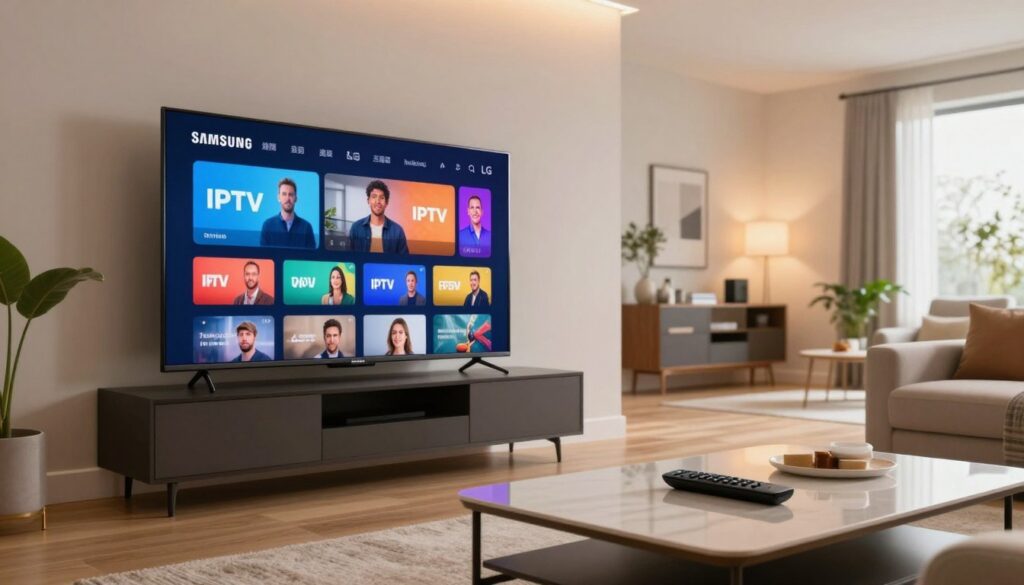
Curious whether you can replace your satellite box with a cleaner, app-based setup on your living room screen?
This short intro explains what an iptv subscription for smart tv in uk samsung lg guide means today: a legal service plus a player app and a steady internet link. You’ll learn why viewers moved to streaming in 2025 and how your existing television can run apps natively.
We’ll focus on the two platform families most homes use: Samsung (Tizen) and LG (WebOS). Expect clear setup differences, app options, and simple buying checkpoints like channel mix, peak-time performance, and 4K readiness.
Later, you can compare providers and see practical steps, troubleshooting tips, and a calm legal note about licensed content. If you want quick provider ideas, check the best UK picks.
Ready to choose? At the end you’ll find a legal-subscription CTA to GetMaxTV to help you move from contract boxes to app-based viewing.
Key Takeaways
- Definition: service + app + reliable internet are required to watch smoothly.
- Platform split: setup and app options differ between Samsung and LG models.
- Buying checks: channels you watch, quality, app reliability, device coverage.
- 2025 expectations: HD/4K, fast channel switching, and a stable EPG matter.
- Legality: apps are players—choose providers with proper licensing.
Why IPTV on Samsung and LG Smart TVs is a popular choice in the UK right now
Using an app to stream channels and libraries directly on your television is simpler than many people expect. It replaces extra boxes and brings live and on-demand content to the same home screen you already use for other shows.
What streaming on a TV really means and what you need
In plain terms: you watch TV channels over the internet through an app instead of via cable or satellite hardware.
Typical provider items:
- A playlist method such as M3U or an Xtream Codes-style API
- An EPG source so your program guide fills correctly
- Login or portal details compatible with the app you choose
How operating systems change the experience
Different OS stores affect which apps appear and how stable they run. Tizen and WebOS use separate app catalogs, so one lightweight player might be better on one platform than the other.
Your experience also hinges on hardware: faster processors and recent firmware improve playback and channel switching. And remember: quality depends on both the provider’s server stability and your set’s app performance during peak events.
| Factor | Tizen (Samsung) | WebOS (LG) |
|---|---|---|
| App store style | Curated store, some strict policies | Open catalog, varied app options |
| Best app type | Lightweight players with playlist upload | Players optimized for channel lists and EPG |
| Navigation | Fast remote search, stable on newer models | Smoother guide handling on recent firmware |
| User trade-off | Simpler setup, fewer external boxes | Good native playback, slightly fewer advanced apps |
If you want a ready app option to try, see the GetMaxTV app page for a legal player that many users install on native sets.
iptv subscription for smart tv in uk samsung lg guide: what to check before you buy

Before you buy, make a clear checklist so you only pay for channels you actually watch.
Channel needs and content categories
List must-have categories first: sports, news, kids, and international. That helps you compare provider options against what you watch daily.
Choosing by category prevents endless scrolling and avoids paying for huge channel lists you’ll never open.
Quality targets that matter in 2025
Set clear quality expectations: stable HD is the baseline and 4K matters only for select live events or native shows.
Look for providers that promise consistent performance during peak events. Stability means quick channel switching, minimal buffering, and no sudden drops.
Support, updates and app reliability
Good support and regular updates save you time when firmware or apps change. Choose services with responsive help and active maintenance.
Confirm the provider supports M3U/Xtream Codes and supplies working EPG links so setup is smooth.
Device limits and multi-room use
If you plan multi-room viewing, check how many devices can stream at once and whether extra device slots cost more.
Also note: very large lists can slow navigation on TV apps. A provider that handles lists smoothly is often better value than the one with the most channels.
- Define must-have channels before you buy.
- Demand stable HD and good peak-time performance.
- Verify support, updates, and EPG compatibility.
- Confirm concurrent device limits and playlist handling.
Samsung Smart TV (Tizen) compatibility and the best app options
Tizen’s app store shapes what will run well on your set. You must match the player to your provider’s delivery method. That means checking whether you get a playlist URL or login codes before you pick an app.
IPTV Smarters is a solid choice if you want a modern UI, built‑in search, and category-focused navigation. It works well when your provider supplies standard login methods. If you prefer to try it, see IPTV Smarters on Tizen.
Smart IPTV (SIPTV): expectations
SIPTV usually needs a playlist upload via a web portal. Some versions require a one-time activation fee. Once active, the layout is simple and remote-friendly.
Lightweight alternatives
Set IPTV and SS IPTV run lighter on mid-range hardware. They handle large playlists with less lag. Choose these when you have long channel lists and want faster navigation.
| App | Best fit | Key requirement |
|---|---|---|
| IPTV Smarters | Modern UI, search, favorites | Provider login or playlist support |
| Smart IPTV (SIPTV) | Clean guide, one-time activation | Playlist upload via portal |
| Set IPTV / SS IPTV | Large lists, mid-range sets | Optimized playlist handling |
- Confirm your provider supplies a usable playlist or Xtream codes before you install.
- Match app navigation to how you browse channels to avoid slow performance.
- Remember storage and remote navigation limits when you build big lists.
LG WebOS compatibility and the best app options
Start by checking the LG Content Store — that single step narrows which player apps will run smoothly on your set.
What to prioritise for smooth navigation
Choose apps that make the remote feel simple. Look for fast category switching, clear search, easy favourites, and an EPG grid that loads without freezing.
Performance often comes from UI efficiency, not just your internet speed. A lean player that manages lists and guide data will feel faster during channel changes.
When simpler players win
Pick SS IPTV or Set IPTV when you have very large playlists and want speed over polish. These apps reduce crashes and keep playback stable in long sessions.
They work best if your provider gives M3U or an Xtream Codes API. Confirm that before you install iptv app choices.
Playlist handling and provider checks
WebOS apps accept playlist URL entry, upload portals, or local import. Clean playlist formatting helps channels populate correctly and keeps lists tidy.
- Verify your provider supports the playlist method you prefer.
- Test a small list first to confirm EPG and channel order.
- Choose a player that keeps clicks low — fewer menus means quicker live viewing.
For a WebOS-focused option and easy setup details, see this LG player page to compare compatible choices and workflow tips.
Setup guide for Samsung and LG: install IPTV apps and sign in the right way
Getting your player app set up correctly makes the rest of the process quick and reliable.
What providers send: most send an M3U playlist URL (the channel list) and an EPG/XMLTV URL for program data. Some give Xtream Codes credentials: a portal URL plus username and password.
Choosing M3U vs Xtream Codes
Xtream Codes often feels easier because the app pulls categories and EPG automatically. M3U is flexible but depends on exact URLs and clean formatting.
Samsung steps
Open the Samsung app store, search your chosen player (try IPTV Smarters or Smart IPTV), install iptv, then paste the playlist or enter Xtream Codes exactly as provided.
LG steps
Open the LG Content Store, install the player app, then load the playlist by URL entry, upload, or portal import. Confirm channels appear and play.
EPG basics and checks
- Attach the EPG data source in app settings and run a manual refresh.
- Set time zone so program times match your region.
- Enable auto-refresh if available to keep the guide updated.
“Enter details exactly as provided; minor typos often cause failures.”
Quick test: play 3–5 channels across categories, check audio sync, and ensure the EPG grid shows current programs before you call the setup done. For a concise QLED setup walkthrough see QLED setup walkthrough.
Features that separate a “good” IPTV experience from a frustrating one
You can judge an app or provider in minutes if you know which features to check first.
Format support that matters
M3U gives you playlist flexibility; it works well when lists are clean and links are stable.
XMLTV (EPG) is essential for a usable program guide. Without it, browsing feels clunky.
Xtream Codes API often simplifies login and keeps categories synced across devices. It improves organization and reduces setup friction.
Usability on the remote
Favorites, quick search, and sensible channel grouping are the shortcuts you’ll use most. Large lists need folders and hide options to avoid noise.
Good organization means stable favourites that don’t reset and fast jump-to-channel behavior.
Streaming controls and catch-up
Look for player choices, adjustable buffer size, and consistent aspect ratio/subtitle handling. These options reduce buffering and sync issues.
Catch-up depends on both the provider feed and the app UI; when supported, it adds real value for news and series.
“Better format support and controls typically mean fewer ‘why won’t this load?’ moments.”
- Use this checklist to compare providers and predict daily performance.
- Test M3U, EPG, and Xtream Codes support before you commit.
- Prioritise remote usability over sheer channel counts.
For a practical look at how features affect the user experience, see this user experience review.
Performance, internet, and troubleshooting on Smart TVs
Slow streams and sudden freezes are usually fixable without technical panic—start with the basics that affect most homes.
Buffering fixes: Ethernet, Wi‑Fi, and resolution
Start with a wired connection. Ethernet reduces interference and often improves performance during peak hours and live sports.
If you must use Wi‑Fi, move the router closer or use a mesh node near the set to boost speed and lower packet loss.
Test quality at HD first; only enable 4K when your internet and provider stability hold up consistently. Lower resolution if buffering persists.
EPG or channel list not loading
Refresh the playlist inside your app and run a manual EPG sync. Typos, expired links, or incorrect data URLs are common causes.
Try a small test playlist to confirm format and ordering before loading a large list.
Crashes, black screens, and when an external device helps
Clear the app cache, free storage space, or reinstall the player to fix crashes caused by limited device memory.
If the set still struggles with big lists or updates, use an external streamer. Android boxes with Google Play access often give better app choice and smoother playback.
“Reboot your TV and router, update the app, check time/date, then retest a few channels before contacting support.”
For an expanded checklist and provider options, see this ultimate selection guide.
Conclusion
In closing, focus on clarity: pick the channels you actually watch, choose a player that runs well on your set, and then compare provider options that support the formats you’ll use.
Today, what matters most is stability at peak times, a reliable EPG, and apps that receive regular updates. Prioritise quality over huge lists — a smaller, smooth lineup often gives a better home viewing experience.
Choose a trusted provider with clear credentials and fast support so setup issues get resolved quickly. For one well-documented option to compare, see this best iptv review.
Legal note: player apps are legal, but content rights matter. If you want a legal subscription, check GetMaxTV’s offer on https://getmaxtv.com.
FAQ
What does IPTV mean on my Samsung or LG set and what will your provider need to give you?
It means you’re streaming live and on‑demand channels over the internet instead of using aerials or cable. Your provider usually supplies either an M3U playlist URL, an XMLTV EPG file, or Xtream Codes details (server, username, password). Keep that information handy when you install an app or load a playlist.
How does streaming differ between Tizen on Samsung and WebOS on LG?
Tizen and WebOS use different app ecosystems and playback engines. Tizen tends to have more native apps in the Samsung Store, while WebOS focuses on simple navigation and lean players. You may find the same service performs slightly differently, so test the app that matches your firmware and choose the one that offers the smoothest remote control and guide display.
What should you check before buying a service for multiple TVs or rooms?
Ask about device limits, simultaneous streams, and whether the provider supports smart TVs and Android boxes. Verify the number of concurrent connections and whether they offer separate login profiles. Also confirm multi‑room EPG and whether they support external players like VLC or native player modes.
Which quality factors matter now: HD vs 4K and peak‑time performance?
Look beyond resolution: stable bitrate, consistent CDN delivery, and adaptive streaming are crucial. HD is fine for most channels, but pick 4K only if you have a fast connection and a 4K panel. Check peak‑hour performance and whether the service scales streams without frequent buffering.
What apps work best on Samsung sets and which one should you try first?
Start with well‑supported players available in the Samsung App Store. Apps like Smart IPTV (SIPTV) and IPTV Smarters are popular because they handle playlists and guides well. Choose the app that supports M3U, Xtream Codes, and external EPGs and that matches your comfort with playlist management.
How do playlist uploads and activation work with Smart IPTV on Samsung?
Smart IPTV typically requires you to enter a MAC address or upload a playlist via a web portal. Activation methods change, so follow the app’s instructions. You usually paste the M3U URL or upload a file, then refresh the app to populate channels and the guide.
What should you prioritize on LG sets when picking a player app?
Prioritize apps that offer smooth remote navigation, clear channel grouping, and reliable EPG mapping. Lightweight players like SS IPTV or Set IPTV often handle large playlists and provide stable performance on WebOS devices.
What does my provider send: an M3U URL or Xtream Codes — which is better?
M3U is a simple playlist file or link that lists channel streams. Xtream Codes (API) offers user authentication, live stream links, VOD, and built‑in EPG mapping. Xtream Codes makes login and guide handling easier, but both are common — choose the method your chosen app supports best.
How do you install and sign in on Samsung via the Samsung app store?
Open the Samsung app store, search for your chosen player, install it, then open the app and enter the M3U URL or Xtream credentials provided by your service. Finally, refresh the playlist and allow any EPG mapping to complete before watching.
How do you install and load a playlist on LG through the LG Content Store?
Find the app in the LG Content Store, install it, then open the app and paste the M3U link or enter API details. Some apps let you upload an XMLTV file separately for a fuller program guide. Save and refresh to populate channels and thumbnails.
How do you set up an EPG so the guide stays updated?
Point your app to the provider’s XMLTV or choose the built‑in EPG mapping option in Xtream Codes. Set a regular refresh interval in the app settings and keep the playlist URL unchanged. If the guide goes stale, reimport the EPG file or refresh the playlist manually.
Which formats should your player support to avoid playback problems?
Ensure the player supports M3U playlists, XMLTV EPG, and Xtream Codes API. Also confirm common codecs and container support (H.264/H.265, TS, HLS). Broad format support reduces mismatches and improves compatibility with many providers.
How can you make navigation easier with large channel lists using your remote?
Use apps that offer favorites, search, and channel grouping. Rename or tag channel groups and build a favorites list to avoid scrolling. Some apps let you hide unused categories, which improves remote usability.
How do you reduce buffering: Ethernet vs Wi‑Fi and router tips?
Wired Ethernet is more stable than Wi‑Fi, especially for HD and 4K streams. If you must use wireless, use a 5 GHz band, position the router near the TV, and minimize interference. Also check your plan speed — aim for 10–25 Mbps per HD stream and 25–50 Mbps for 4K.
What to do if the channel list or EPG won’t load?
First refresh the playlist and EPG, then restart the app or the TV. Check the M3U URL or API credentials for typos. If the provider uses a token or rotating link, contact support. As a last resort, reimport the playlist or switch to an alternative player.
What fixes crashes or black screens on playback?
Clear the app cache, free up TV storage, and ensure firmware and app versions are up to date. Lower the playback resolution or try another player. If problems persist, use an external Android box or Amazon Fire device for more stable playback.
Are Android boxes or external players worth using with modern TVs?
Yes, external devices often offer better app choice, more processing power, and easier sideloading. If you hit storage or codec limits on the TV, a small Android box or Amazon Fire TV can provide smoother performance and more frequent updates.
How do you pick a trustworthy provider with reliable content and support?
Look for providers with clear channel lists, uptime guarantees, active support channels, and recent user reviews. Check whether they provide regular updates, secure payment methods, and options for trial access so you can test performance before committing.
The GetMaxTV Team is a group of cord-cutting experts and streaming technology specialists who have been testing and reviewing IPTV services since 2022. Based in North America, our team personally tests every service we recommend across 15+ devices including Fire TV Stick, Roku, Apple TV, Samsung Smart TVs, and gaming consoles. We verify channel counts, measure buffering rates, test picture quality in HD and 4K, and evaluate customer support response times. Our mission is to help viewers save money by switching from expensive cable subscriptions ($147/month average) to affordable, high-quality IPTV alternatives. Every article on GetMaxTV.com is based on hands-on testing and real-world experience — not recycled marketing claims.